
At the Back, As it Remains
William Carlos Williams, Mark Twain, and Cornell West on the American Grain

Lately I’ve been reading William Carlos Williams’ 1925 essay collection-as-prose poem In the American Grain. A curious collection of quasibiographical writings on the theme of American history, Williams begins with Erik the Red fleeing a murder rep in Iceland and discovering Greenland, and brings his discourse to a close with a chapter on Abraham Lincoln. The attitude of the text is an interesting one often found in works of roughly this period, when the foundational conquests of the new world no longer seemed entirely laudable, but before it was thought of as a crime of singular, world-historical proportions.
Spain cannot be blamed for the crassness of the discoverers. They moved out across the seas stirred by instincts, ancient beyond thought as the depths they were crossing, which they obeyed under the names of King or Christ or whatever it might be, while they watched the recreative New unfolding itself miraculously before them, before them, deafened and blinded. Steering beyond familiar horizons they were driven to seek perhaps self-justification for victorious wars against Arab and Moor; but these things are the surface only. At the back, as it remains, it was the evil of the whole world; it was the perennial disappointment which follows, like smoke, the bursting of ideas. It was the spirit of malice which underlies men’s lives and against which nothing offers resistance. And bitter as the thought may be that Tenochtitlan, the barbaric city, its people, its genius wherever found should have been crushed out because of the awkward names men give their emptiness, yet it was no man’s fault. It was the force of the pack whom the dead drive. Cortez was neither malicious, stupid nor blind, but a conqueror like other conquerors.
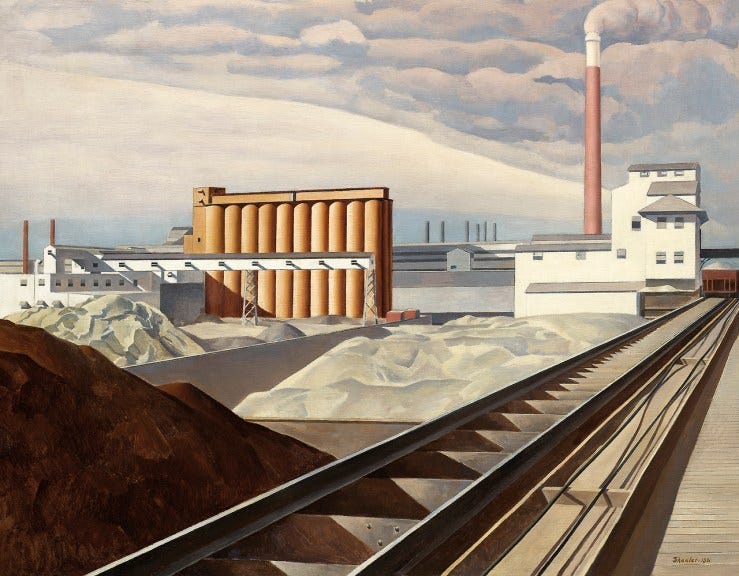
Religiously I tend to associate Williams with the kind of agnostically-hostile-to-religion poet-is-priest art worship one finds in many of the other great modernists. His poem “The Host” exemplifies this, closing with an assertion that it is the poet, and not the representatives of this or that religion who makes the divine manifest within the created world.
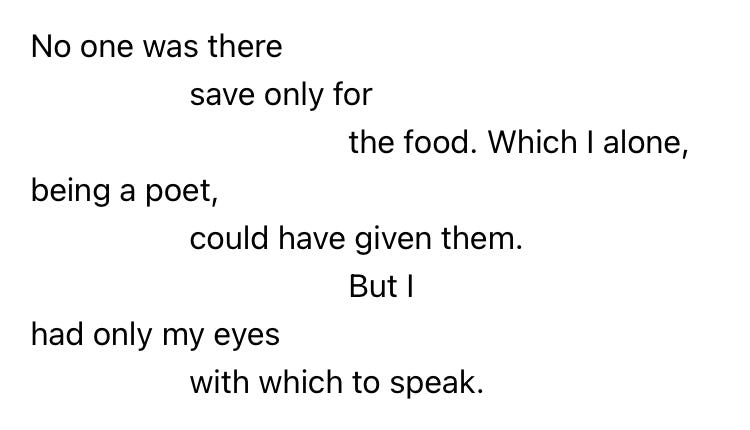
I was thus somewhat surprised to find a number of effusive passages on the Roman church in the middle of the chapter of In the American Grain on Fr. Sebastian Rasles and the 16th and 17th century efforts of the Jesuits in French Canada.
One should read the Lettres Edifiantes, I think one would understand better how much we are like the Indians and how nicely Catholicism fits us. What would Mather think today of Catholic Boston? It is inevitable, I said. THis is America. If the Puritans have damned us with their ab-stinence, removal from the world, denial, slowly we are forced within ourselves upon an emptiness which cannot be supplied,-this IS the soul, according to their tenets. Lost, in this (and its environments) as in a forest, I do believe the average American to be an Indian, but an Indian robbed of his world-unless we call machines a forest in themselves. It would be diverting to believe, if it were so, as I think it’s proving, that despite its obvious benefits, such Protestant-ism, in America, would have Catholicism, as its consequence. This and the accumulation of great staying wealth.
From lack of touch, lack of belief. Steadily the individual loses caste, then the local government loses its authority; the head is more and more removed. Finally the center is reached-totally dehumanized, like a Protestant heaven. Everything is Federalized and all laws become prohibitive in essence.
I was fascinated to find in this chapter premonitions, in a so-canonical you barely-hear-about-him-anymore-outside-the-anthologies author, of an attitude toward Roman Catholicism that I associate very strongly with our own time. This might be thought of as an aestheticist variation of the “mimetic Christianity” recently in vogue on the right, and which Tara Isabella Burton, Matt Whiteley and others have written convincingly against. In this view, the Roman church’s emphasis on external beauty and works provides a more solid basis for an American Aesthetic than the frigid Calvinism of the Dutch and English settlers, and the (in this view) stupid left-liberalism which is their progeny, which sees art only instrumentally and is in any case skeptical of its adoration.
And so America is become the greatest proselytizing ground for the Catholic in the world today-in spite of everything. The difficulty, from lack of sensual application, emoved from without by an authority that represents the mystery itself-leaves hands freed for embraces, a field where tenderness may move, love may awaken and (save by the one blocked door) a way is offered.
Certain it is that the New World suffered greatly from both Puritans and Catholics; but as Père Rasles touched it nearer than his southern neighbors, and as the ghost of Puritanism still binds us by its horrid walls, so, as a corollary, Catholicism gains in that it offers us ALLEVIATION from the dullness, the lack of touch incident upon the steady withdrawal of our liberty.
Each of the various essay-prose poems in the book is to some varying extent written from within the consciousness of its subject, so how much this reflects Williams actual views is unclear. His poetry is not always laudatory to any faith, but one wonders…
Brief Thoughts on Puddin’head Wilson
I was moved by a recent Invisible College Episode and Isaac Kolding’s post on it from last month to once more think about Mark Twain’s Puddin’head Wilson, a book I read between Edith Wharton’s The House of Mirth and William Faulkner’s The Sound and the Fury in a Major American authors II course at the very end of my undergraduate education. The professor teaching the course described it as “maybe Twain’s most cynical book” while introducing it to us. I have always thought there was something to this, and that the book has a certain kinship with something like Madame Bovary as an ultimately nihilistic attack on the whole of the nineteenth century society which produced it. There is a Homais-like stupidity to the titular character’s attempts to enlighten his community, attempts which only affect the unhappy restoration of what Twain clearly views as an evil social order. The difference I think, is that however nihilistic Flaubert may be, there is a sense in his work that beauty somehow redeems or provides meaning to an otherwise entirely wretched and stupid world. In Twain’s late work this sense is lacking-if all the world is artifice, it is not a pretty painting or an epic so much as a bad joke, meaningless thoughts echoing in empty space forever. Which of these visions one finds more persuasive is probably a matter of temperament.1
The Evasion of American Philosophy: Brief thoughts and excerpts
Over the last few months I’ve been exploring some of the native manifestations of that which passes for philosophy in these United States. Along the way I have often turned to the entertaining, useful survey from within this tradition that is Cornel West’s 1989 book The American Evasion of Philosophy.2
the evasion of epistemology-centered philosophy - from Emerson to Rorty - results in a conception of philosophy as a form of cultural criticism in which the meaning of America is put forward by intellectuals in response to distinct social and cultural crises. In this sense, American pragmatism is less a philosophical tradition putting forward solutions to perennial problems in the Western philosophical conversation initiated by Plato and more a continuous cultural commentary or set of interpretations that attempt to explain America to itself at a particular historical moment.
Over the course of drafting this post it’s become clear that West’s book is a rich enough text to justify its own full-fledged post at some point, so I’ll be brief in sketching my main points. In the middle chapters West identifies “crisis of American Pragmatism” that followed John Dewey, when the loyalties of American thinkers became divided between corporate liberalism and various permutations of, and doctrines derived from Marxism.
Dewey’s project never really got off the ground. Like Emerson’s moralism, Dewey’s culturalism was relatively impotent. Why? Principally because his favored historical agents- the professional and reformist elements of the middle class - were seduced by two. strong waves of thought and action: managerial ideologies of corporate liberalism and bureaucratic control, and Marxist ideologies of class struggle and party organization.
This binary strikes me as being, in broad strokes, still true, with the addition of a third temptation on the right. One might call it Hegemonic techno-feudalism, Caesaro-populism, American Bonapartism, or if you really feel that way (and I’m not entirely sure that I do,) fascism. in any case it never quite made it in 20th century America, perhaps excluding Huey Long’s Louisiana, but it’s here now, and provides for some a seductive alternative to these options.
West opposes in an Emersonian spirit the technocratic turn in American life which followed the Second World War, and has survived the various attempts to return to a simpler and more dynamic settlement by means of popular revolt-the upheavals of the 1960s- or various elite actions and aspects of the network of shifts in political economy that have become known as “neoliberalism.” There is something to the critique in our time, which I associate with post-leftists and the practitioners of a “right-critical theory,” of the way that this technocracy has used the “sinister side” of American history to legitimate its own existence.3
The professional incorporation of former New Left activists who now often thrive on a self-serving careerism while espousing rhetorics of oppositional politics of little seriousness and integrity.
On the other hand it has always seemed that the contemporary critique (as distinct from West’s) overcorrects, dismisses the reality of this sinister underside as only an alibi for the will to power. One of the essential dialectics of American history for most of this country’s existence has been oscillation between usually brief, prophetic periods of attempting to “achieve our country” (to steal and possibly misuse Rorty’s phrase,) and long epochs where exhausted ex-reformers settle down and agree to disagree about IE; the humanity of various inhabitants of the nation.4 Some part of me still thinks we’re in one of those refractory periods, but for the fact that the red tribe appears to be trying for a prophetic period of their own at the moment.
I’m just residually Calvinist enough, even as an icon-owning, occasionally rosary-praying Episcopalian, to think a world-enclosing novel or a well-wrought urn is not really enough to compensate us for the absolute meaninglessness of all things.
I am as interested in North American idealism, in figures such as Josiah Royce, (claiming him inasmuch as he died in Massachusetts) Alfred North Whitehead not to mention the various Canadians.
I take what I like to call a “Rockefeller Republican” position on the United States’ post-New Deal technocracy. It exists, and is for the most part, a public good. Certainly elements have grown sclerotic and dysfunctional and thus should be reformed & made more efficient, but trying to uproot the administrative state root and branch to replace it with some sort of personalist Neo-graft system seems at best foolish and counterproductive.
John Encaustum was moved by the sentiment that this belonged on a shirt to make this a reality, and was kind enough to allow me to post it here:
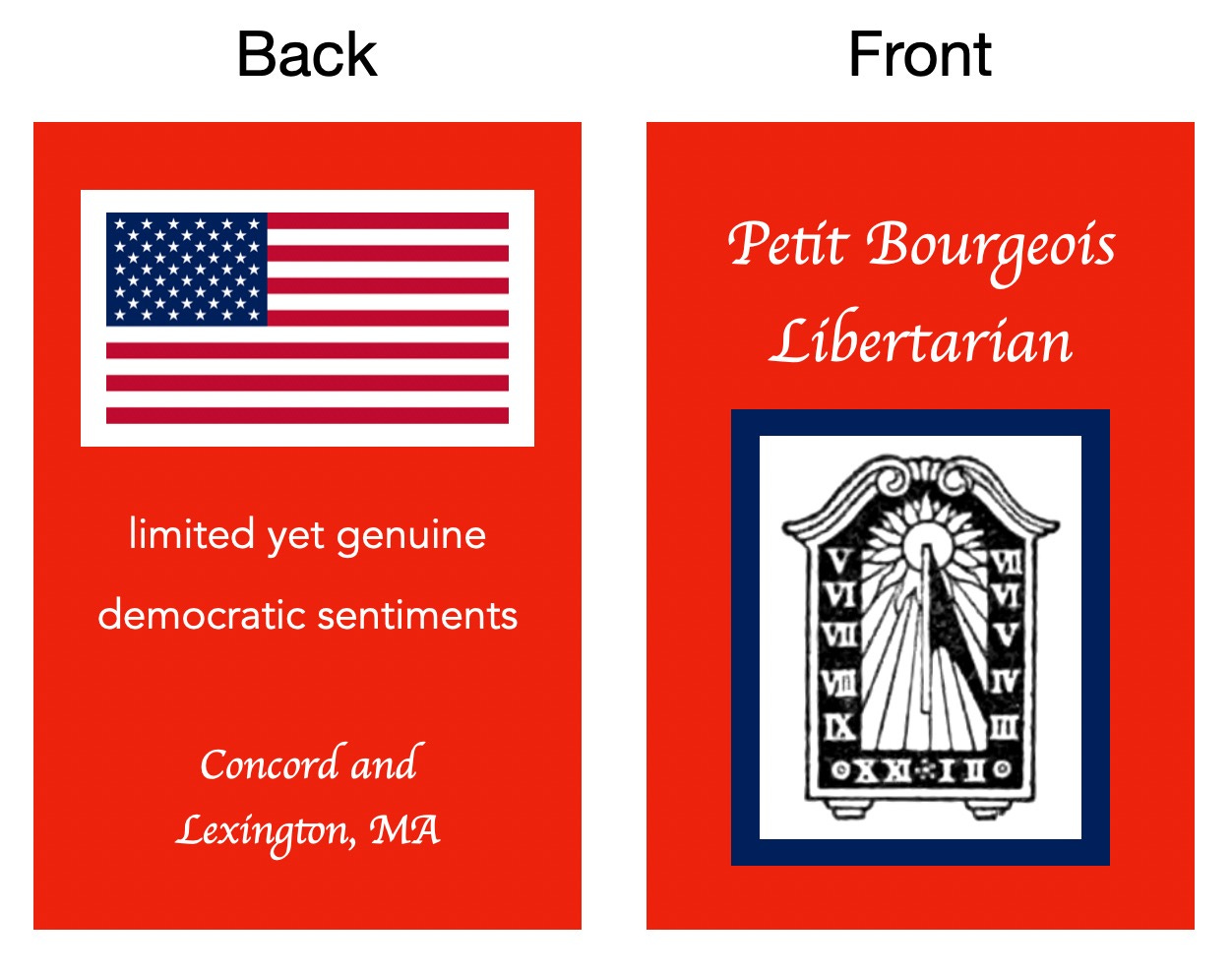
You guys forgot the “with at times anarchist tendencies.”
Wonderful synthesis here. Your reading of West's framing of American pragmatism as cultural criticismreally clarifies why these three fit together so well despite being a century apart. The through line from Williams' ambivalence about conquest to Twain's cynicism to West's identification of that corporate liberal/Marxist binary feels like it tracks something genuine about the American intellectual tradition. I'm particualrly struck by your point about how we might be in a refractory period except that the red tribe is attempting their own prophetic moment right now.